Hand & Foot: Play Online for Free (Solo & Multiplayer)
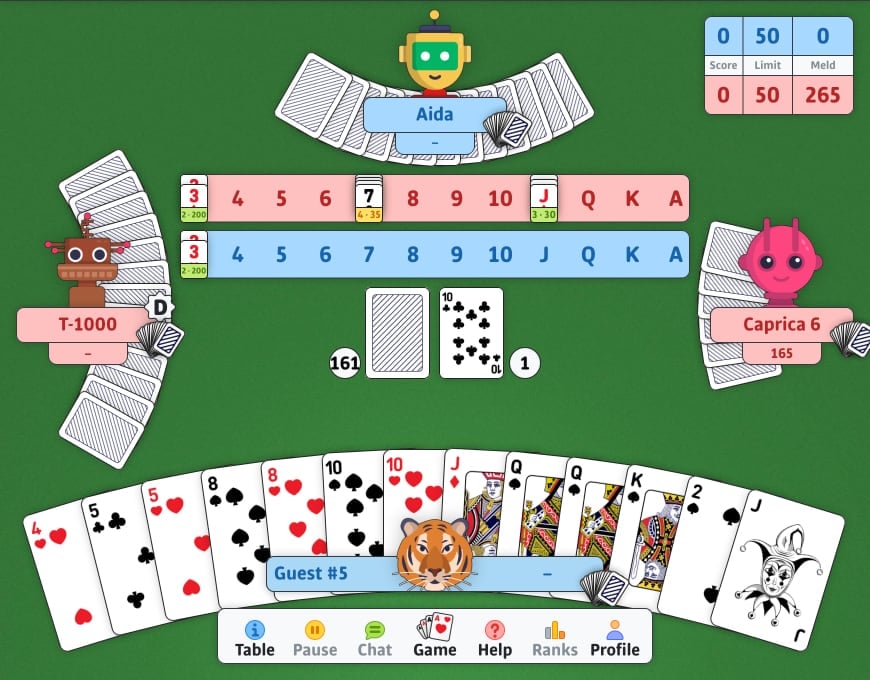
Hand & Foot is a captivating rummy-style card game that adds unique twists to the classic Canasta formula. This 4-player partnership game challenges you to work through two separate hands of cards while creating melds and completing books. With its distinctive wild book mechanic and multi-deal structure, Hand & Foot offers deep strategic gameplay that rewards careful planning and teamwork.
Be the first to rate Hand & Foot
Play free Hand & Foot online against the computer, team up with other players online, or create a private table for you and your friends.
Hand & Foot by the numbers
Real totals from every game of Hand & Foot played on World of Card Games, updated August 2026.
- Games played here: 443,000
- Average game length: about an hour
- Combined playtime: 74 years
- Human players win: 53% of their finished games
Rules
Here's everything you need to play your first game. For the complete reference and an interactive tutorial that walks you through a real game, see our guide on how to play Hand & Foot.
Objective
Hand & Foot is a partnership melding game from the Canasta family. You and your partner lay down melds of same-rank cards and grow them into seven-card books. A game lasts exactly four deals, and the team with the higher total score at the end wins.
The deal and the two hands
Four players in two teams of 2 play with five full decks plus Jokers shuffled together, 270 cards in all. Each player gets an 11-card "hand" and a separate 13-card "foot" that stays face down. You play your hand first and can't look at your foot until every card in your hand is gone. After the deal, one card is turned face up to start the discard pile.
The play
On your turn you draw two cards from the stock, or take the top seven cards from the discard pile if you can immediately meld its top card with two matching natural cards from your hand. Then you may lay down melds of 3 to 7 cards of the same rank. Wild cards (2s and Jokers) can fill in, but a mixed meld needs at least twice as many natural cards as wilds. The one exception is a meld made entirely of wilds. Your team's first meld of each deal must be worth a minimum that rises from deal to deal, 50 points in deal 1, then 90, 120 and 150. You end your turn by discarding one card.
A few cards behave differently. Red 3s go straight to the table the moment you draw one, and you draw a replacement card. Black 3s can never be melded. While a black 3 is the top card of the discard pile, no one can take the pile. When your hand runs empty you pick up your foot and keep playing.
Scoring and winning
A meld that reaches seven cards becomes a book and closes. A clean book (no wilds) scores 500 points, a dirty book (one or two wilds) scores 300, and a wild book (seven wilds) scores 1,500. To end a deal by "going out", your team needs at least 2 clean books, 2 dirty books and 1 wild book, both you and your partner must have picked up your feet, and your partner has to give you permission. Going out is worth a 100-point bonus. Teams then add the value of every card they melded, plus 100 for each melded red 3, and subtract the value of cards left in hands and feet along with 100 for each unmelded red 3. After four deals the higher total wins, and a tie is settled with one extra deal.
How to win at Hand & Foot
These tips come from real games on this site. The two big skills are pacing your two hands and spending wild cards at the right moment.
Your hand and your foot:
- Keep pairs of natural cards together. Two naturals matching the top discard are what let you take the seven-card pickup.
- Try to reach your foot by melding the last card of your hand during your turn. You pick up the foot immediately and keep playing. Discard it instead and the foot waits until your next turn.
- Save wild cards for later in the deal when you can. They're often more useful once you're into your foot and know what you're working with.
- If your team can't go out yet, you must keep at least two cards while playing from your foot, so don't meld yourself into a corner at the end of a deal.
Wild cards and books:
- Track the going-out requirements from the first turn. Your team needs 2 clean books, 2 dirty books and 1 wild book every deal, so know which ones are still missing.
- The wild book alone eats seven wild cards. Every 2 you spend propping up an ordinary meld is a card that book won't get, so coordinate with your partner on who collects wilds.
- Finish melds clean when you can. A clean book is worth 500 points against 300 for a dirty one, but a well-placed wild completes a book faster, so weigh the extra points against the speed.
- Melds of up to five cards can hold only one wild. The second wild has to wait until the meld reaches six cards.
Partnership and the pile:
- Watch your partner's melds and discards. Melds belong to the team, so add to ranks you've already opened instead of scattering points across new ones.
- Taking the pile hands you up to seven cards, but it also refills a hand you may be trying to empty and shows opponents what you're collecting. Make sure the extra cards are worth it.
- Discard a black 3 to block the pile when it's grown valuable and an opponent looks ready to take it.
- Don't rush to go out. Every card left in your team's hands and feet counts against you, so if your partner is still loaded, the answer to "may I go out?" is often no.
Frequently asked questions
What's the difference between hand and foot?
Your "hand" is the first set of 11 cards you play. Your "foot" is a second set of 13 cards that remains face-down until you've played all cards from your hand. You cannot look at your foot until your hand is empty.
How do wild books work?
Wild books consist of exactly seven wild cards (2s and/or Jokers) and are worth 1,500 points. You must complete at least one wild book to go out. They're valuable but require collecting many wild cards.
What are the going out requirements?
To go out, your team must have completed at least 2 clean books (no wilds), 2 dirty books (with wilds), and at least 1 wild book. Both you and your partner must have picked up your feet, and you must ask for and receive their permission.
How does scoring work across deals?
Your score carries over from deal to deal. After each deal, your team adds points for completed books, melded cards, and bonuses, then subtracts the value of cards left in hands and feet. The team with the highest total after 4 deals wins.
Can I pick up the entire discard pile?
No, unlike Canasta, you can only take the top 7 cards from the discard pile (or all cards if fewer than 7 are present). You must be able to immediately meld the top card with two matching cards from your hand.
How do I play Hand & Foot with friends?
Create a private table and share its name. Click the Menu button, check Private Table, then click Change next to Name and enter a table name. Friends who enter the same name at their own private table join yours.
Can I play Hand & Foot against the computer?
Yes. Click the little grey robot next to any empty seat to invite a bot. Fill all three seats with bots and you can play entirely solo, with one bot as your partner and two as opponents.
Can 2 people play Hand & Foot?
Hand & Foot is a 4-player partnership game, so two people can't play it alone. You and a friend can share a private table and fill the two empty seats with bots. Sit across from each other to play as partners, or side by side to face each other with bot partners.
How long does a game of Hand & Foot take?
About 2 hours on average across the games played on this site. A full game always runs four deals, and every player works through both a hand and a foot in each one.
Is Hand & Foot free to play here?
Yes. Hand & Foot is free in your browser with no download and no signup. You only need an account if you want to keep long-term stats or play ranked games.
What games are similar to Hand & Foot?
If you enjoy Hand & Foot, try the site's other rummy games, such as Gin Rummy, Rummy and Canasta.
